The standards are strong but dense, and written for far larger organizations. We translate them into a plan your team can run — and one assessment maps your posture across all of them at once.
The “what” and “why” of AI risk management, through four functions: Govern, Map, Measure, Manage. It’s the backbone of every engagement.
The Generative AI Profile and its twelve risk categories — the organizing spine of our AI Adoption Assurance service.
Core cybersecurity outcomes — Identify, Protect, Detect, Respond, Recover — that AI security has to sit on top of, not beside.
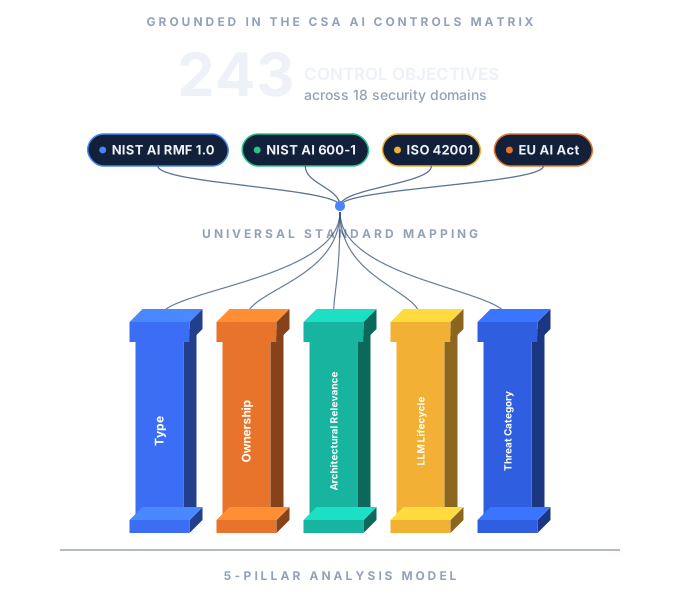
A vendor-agnostic matrix of 243+ control objectives across 18 domains — the tactical engineering detail behind the strategy. See the AICM Playbook →
The AI management-system standard — the operating structure for governing AI responsibly over time.
Risk-tiered regulatory obligations. We map exposure proportionally, so readiness scales with actual risk — not fear.
NIST AI RMF gives you the “what” and “why.” The CSA AI Controls Matrix gives you the “how.” We connect the two — turning high-level risk language into specific, owned engineering objectives, mapped to the compliance regimes you already answer to (ISO 42001, SOC 2, HIPAA, and the EU AI Act).
We use the CSA AI Controls Matrix — 243+ control objectives across 18 domains — as the foundation, and align it to NIST AI RMF, the NIST AI 600-1 Generative AI Profile, ISO 42001, and the EU AI Act. Every control is then analyzed on five practical pillars — Type, Ownership, Architectural Relevance, LLM Lifecycle, and Threat Category — and we customize the set to the controls that make the most sense for your organization, never a one-size-fits-all checklist.
Our AI Adoption Assurance engagement gives you a documented, reasoned position on every one of these — assessed per use case as in scope, monitor, or out of scope.
Lowered barriers to chemical, biological, radiological, or nuclear information and capabilities.
Confidently stated false or misleading content — the “hallucination” problem.
Generation of dangerous, violent, or hateful content at machine scale.
Leakage or misuse of personal and sensitive data through prompts, training, or outputs.
The energy and resource footprint of training and running generative models.
Amplified bias and homogenization — outputs that narrow or skew at scale.
Over-reliance, automation bias, and unclear roles between people and the system.
Degraded trust in information — disinformation, deepfakes, and synthetic media.
An expanded attack surface: prompt injection, data poisoning, and model theft.
Infringement or leakage of IP through training data or generated outputs.
Generation of obscene, degrading, or non-consensual content, including CSAM risk.
Risks inherited from third-party data, models, and components in the supply chain.
The frameworks tell you what and why. Our AICM Playbook is the layer that tells you how: the domain topology, the five-layer shared responsibility cascade, the controls that sit inside a single AI request, and what changes between pre-production testing and live telemetry.
Not another GRC engagement. We speak these frameworks fluently so you don’t have to — giving you the controls that matter, sized for the mid-market, mapped straight to business outcomes. Defensibility, not paperwork.
One free assessment shows where you stand against the frameworks that matter — and a right-sized path to close the gaps.
Request a Free Assessment